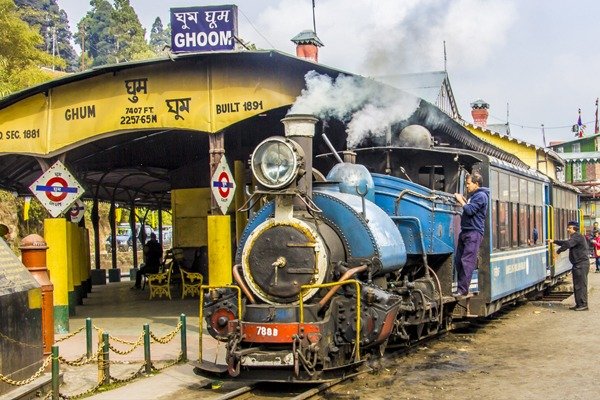
About the Darjeeling Himalayan Railway – A Brief History
The Darjeeling Himalayan Railway (DHR) is one of India’s most remarkable mountain railways. Known affectionately as the “Toy Train,” the railway has connected the foothills of the Himalayas with Darjeeling for more than a century. Its remarkable engineering, historic steam locomotives, and spectacular mountain scenery have made it an important part of Darjeeling’s heritage.
The Beginning of the Darjeeling Himalayan Railway
1879 – Construction Begins
The Darjeeling Steam Tramway Company began constructing the railway in 1879. Engineers built the line to a narrow gauge of just 2 feet (610 mm). The main aim was to reduce the cost of transporting essential goods, including rice, to Darjeeling. The railway also supported the growth of local industries, particularly tea production.
The route closely followed the existing Hill Cart Road. The Government supported the project because the railway could also reduce the cost of maintaining the road.
1880 – The First Steam Locomotives
Eight steam locomotives arrived from Sharp Stewart & Co. of Manchester, England. In March, Lord Lytton, the Viceroy of India, visited the developing railway.
By August, the railway opened to the public between Siliguri and Kurseong, marking an important step in the region’s transportation history.
1881 – The Railway Reaches Darjeeling
On 3 July 1881, the railway officially reached Darjeeling. At the time, the route covered approximately 51 miles (82 km).
The railway climbed from around 400 feet (120 m) at Siliguri to Ghum at 7,407 feet (2,257 m) before descending to Darjeeling at approximately 6,812 feet (2,075 m).
The company then adopted the name Darjeeling Himalayan Railway Company. During its first full year, the railway carried around 8,000 passengers and 380 tons of goods.
Expansion and Engineering Achievements
1882–1899 – Improving the Mountain Route
In 1882, engineers constructed four loops and four reverses, or zig-zags, between Sukna and Gayabari. These engineering features helped the trains manage the steep Himalayan gradients.
In 1885, the railway extended a short goods line to the bazaar at Darjeeling. The railway continued to expand during the following years. Darjeeling station underwent reconstruction in 1891, while Kurseong received a new station and storage sheds in 1896.
Natural disasters also tested the railway. An earthquake damaged homes in Darjeeling and Kurseong in 1897, although the DHR maintained its services. Then, in September 1899, a devastating cyclone caused a major landslide. Around 4,000 feet of mountainside slipped into the valley, causing extensive damage and loss of life.
Growing Passenger and Freight Traffic
By 1905, railway traffic had grown significantly. The DHR carried approximately 29,000 passengers and 31,570 tons of goods. Besides rice, flour, and coal, the railway increasingly transported tourists travelling to Darjeeling.
Traffic continued to rise between 1909 and 1910. The railway carried approximately 174,000 passengers and 47,000 tons of goods. During this period, the DHR introduced its first bogie carriages, replacing the earlier basic four-wheel carriages.
1914–1919 – Further Expansion
During 1914–15, the railway opened a branch line from Siliguri to Kishanganj. At the same time, the railway relocated its engineering works at Tindharia to a much larger site created by removing the summit of Selim Hill.
The railway carried approximately 250,000 passengers and 60,000 tons of freight. Its freight traffic included flour, rice, tea, potatoes, salt, sugar, and metals.
As the railway expanded, its headquarters moved from Darjeeling to larger premises in Kurseong.
In 1915, another important branch, the Teesta Valley Line, opened between Siliguri and Kalimpong Road at Gielle Khola.
The famous Batasia Loop followed in 1919. Engineers created the loop to provide an easier gradient on the final ascent towards Darjeeling.
Competition from Road Transport
The DHR soon faced competition from buses. By 1919, buses could complete the journey in around 3½ hours, approximately 1½ hours faster than the railway.
The railway responded by introducing a railcar in 1920. However, the small vehicle carried only nine passengers and soon left service.
Despite growing competition from buses and private cars, the railway continued to play an important role in the region.
The Railway and Mount Everest Expeditions
During 1921, 1922 and 1924, the DHR and Teesta Valley Line transported people and equipment for expeditions attempting to reach the summit of Mount Everest.
The railway therefore contributed not only to regional transport but also to some of the early Himalayan mountaineering expeditions.
By 1930, the railway continued to carry large volumes of passengers and goods. It transported approximately 258,000 passengers and 80,000 tons of goods, although competition from road transport began to affect earnings.
Earthquake, War and Recovery
In 1934, a major earthquake in Bihar shook much of Northeast India. The disaster severely damaged buildings in Darjeeling and affected the railway. Nevertheless, the DHR recovered quickly and transported essential materials needed for repairs.
By 1936, the railway operated three through trains each day in both directions. These journeys took approximately 5¼ hours. Local services also operated between Tindharia and Kurseong.
1939–1945 – The Second World War
World War II dramatically increased traffic on the DHR. The railway transported military personnel and supplies to numerous camps around Ghum and Darjeeling.
The railway operated 39 working locomotives, while the Tindharia Works employed almost 400 people. The workshops also constructed additional rolling stock, including a five-vehicle ambulance train for wounded personnel.
A Walford diesel locomotive arrived in 1942 for testing, but the trials did not prove successful.
During 1943–44, the railway carried approximately 311,000 passengers and 76,000 tons of goods.
Indian Government Ownership
In 1947, the railway replaced Darjeeling’s old wooden station with a modern concrete building.
The following year marked another major change. On 20 October 1948, the Indian Government purchased the Darjeeling Himalayan Railway and incorporated it into the Indian Government Railways system.
After Partition disrupted the main railway connection with Assam, authorities converted sections of the DHR branch lines to metre gauge as part of the Assam Rail Link Project.
In 1950, the DHR came under the management of Assam Railways. It later became part of the North Eastern Railway zone in 1952 and the North East Frontier Railway zone in 1958.
New Jalpaiguri Connection and Changing Times
In 1962, engineers realigned and extended the railway at Siliguri by approximately 4 miles (6 km) to connect with the new broad-gauge railway at New Jalpaiguri (NJP).
The new connection opened for freight traffic in 1962 and for passengers in 1964. The railway also moved its locomotive shed and carriage depot from Siliguri Junction to NJP.
By 1984, improved road transport had brought an end to the railway’s historic mail services.
Civil unrest later caused a major interruption. The railway remained closed for approximately 18 months during 1988–89.
By 1993, increasing competition from road transport and previous service interruptions had brought the DHR’s freight operations to an end.
UNESCO World Heritage Recognition
A new chapter began in 1999, when UNESCO awarded the Darjeeling Himalayan Railway World Heritage status.
The DHR became only the second railway in the world to receive this recognition. UNESCO highlighted the railway as an outstanding example of how an innovative transportation system influenced the social and economic development of a multicultural region.
Today, this heritage recognition remains one of the most important milestones in the history of the Darjeeling Himalayan Railway.
The DHR in the 21st Century
In 2000, the railway introduced two NDM6 diesel locomotives. Operators initially used them mainly on services below Kurseong, while steam locomotives continued to operate between Kurseong and Darjeeling and on tourist specials.
In 2002, railway authorities tested oil-firing on steam locomotive No. 787. However, subsequent trials and modifications failed to make the system successful.
During 2003–04, further track realignment took place around Siliguri and New Jalpaiguri because of the broad-gauge conversion of the Assam railway route. The DHR also received a new island platform at NJP.
In 2005, two new oil-fired steam locomotives, Nos. 1001 and 1002, arrived. However, design problems prevented them from entering regular service. At the same time, tourist demand increased, with 82 steam-hauled charter trains operating compared with 20 or fewer in previous years.
Preserving a Historic Railway
In 2006, authorities restored the historic Elysia Building in Kurseong, once the residence of the DHR’s General Manager before 1948.
Two additional NDM6 diesel locomotives arrived from the Matheran Railway. Indian Railways also celebrated the DHR’s 125th anniversary with special “Steam on Three Gauges” charter trains at Siliguri Junction.
The railway appointed its first full-time Director in 2007. Heavy monsoon rains disrupted services and badly damaged the Darjeeling locomotive shed. Nevertheless, the railway introduced the Himalayan Princess daily service and additional Darjeeling–Ghum tourist trains.
In 2008, the railway ended its oil-firing trials and continued using coal for its steam locomotives. Workers also renovated the Tindharia Works. Political unrest and strikes continued to affect services, while a major washout in June closed the Kurseong–NJP section for around ten weeks.
Storm damage caused another major interruption in 2009, closing the railway for almost three months. Major repair work began at Darjeeling Station and the locomotive shed. The railway also introduced ten new corridor-connection carriages.
A Living Heritage of the Himalayas
More than a century after its construction, the Darjeeling Himalayan Railway remains an extraordinary example of railway engineering and mountain transportation.
From its original role in transporting rice, tea, coal, and other goods to its modern role as a celebrated heritage railway, the DHR has evolved with the region around it. Its steam locomotives, loops, zig-zags, mountain landscapes, and historic stations continue to attract travellers from around the world.
Most importantly, the railway preserves a remarkable chapter in the history of Darjeeling and the Eastern Himalayas. Its journey from a practical transportation project to a UNESCO World Heritage Railway reflects the enduring cultural, economic, and engineering significance of the Darjeeling Himalayan Railway.
Historical information courtesy of Paul Whittle, Public Relations Officer, and the late Terry Martin, Archivist of the Darjeeling Himalayan Railway Society.